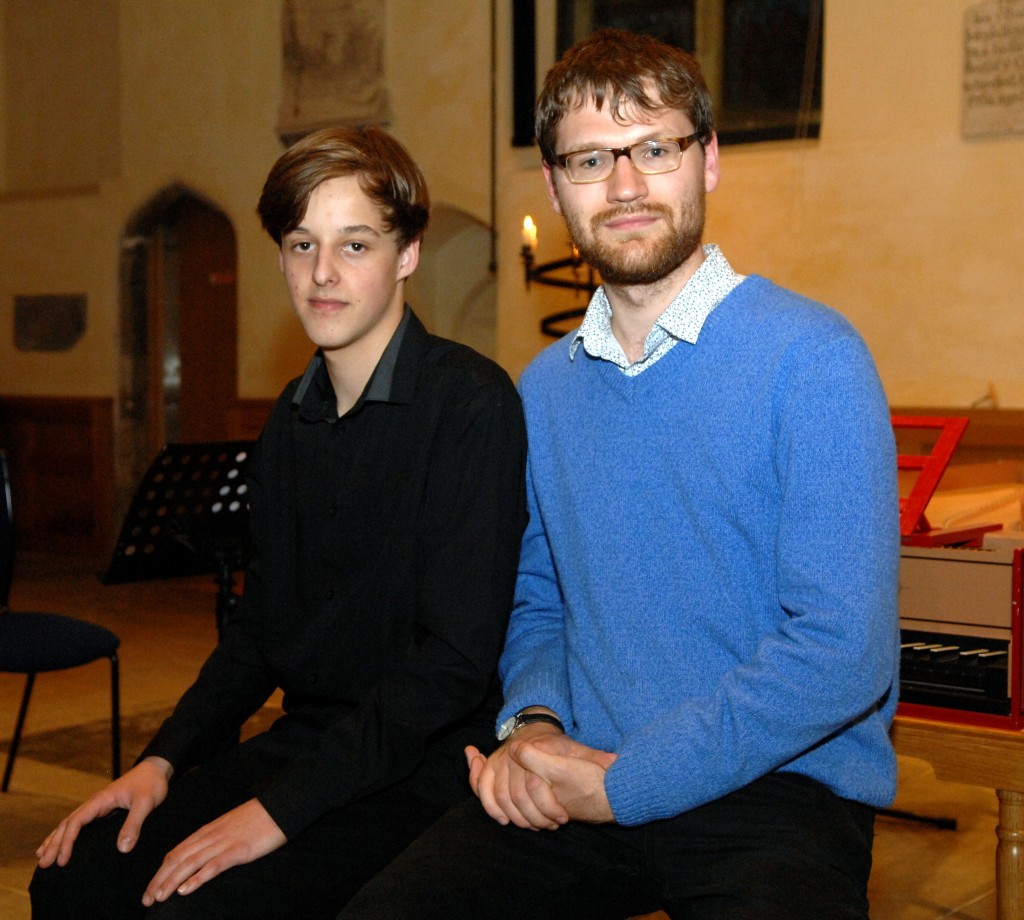
NCEM young composers award 2015 winners announced
The NCEM Young Composers Award 2015, presented in partnership with BBC Radio 3 and the internationally acclaimed Dunedin Consort, has been won by Joshua Urben (aged 16) in the 18 years and under category and by John Goldie-Scot (aged 25) in the 19 to 25 years category.
Joshua Urben’s Fractos Corde and John Goldie-Scot’s Why are you in such a hurry? will be premiered by the Dunedin Consort in Glasgow on Friday 2 October. This concert will be recorded for broadcast on BBC Radio 3’s Early Music Show at 2.00 pm on Sunday 1 November 2015. For more details see: www.bbc.co.uk/radio3/earlymusicshow
Young composers, resident in the UK, were invited to create new settings for a short dramatic scene from one of two Monteverdi masterpieces: Orfeo or Il combattimento di Tancredi e Clorinda. Students were provided with an English translation of the texts, which could be cut or adapted as appropriate. The new works had to be written for two or three singers, accompanied by a small ensemble of instruments, similar to those available to Monteverdi.
Seven finalists were selected and invited to the National Centre for Early Music in York on Thursday 14 May, when their entries were presented by the Dunedin Consort, directed by John Butt keyboards with Mhairi Lawson soprano; Nicholas Mulroy tenor; Jon Stainsby bass; Pamela Thorby, Frances Norbury recorders; Huw Daniel, Colin Scobie violins and Alison McGillivray viola da gamba in a workshop led by Christopher Fox, composer and Professor in Music, Brunel University, London.
At 7.30pm on the same day, the Dunedin Consort performed each of the pieces at a public concert in the presence of a panel of judges comprising Delma Tomlin, Director of the National Centre for Early Music, Les Pratt, Senior Music Producer BBC Radio 3 and John Butt, Director of the Dunedin Consort.
Delma Tomlin, Director of the NCEM noted:
“It has been a privilege to have been part of such an extraordinarily rich and creative environment throughout the workshops and performances. To hear these young composers and players working together to create a reflection of the magic of Monteverdi from a 21st century perspective has been thoroughly inspiring and very enjoyable.”
Les Pratt, Senior Producer BBC Radio 3 said:
“BBC Radio 3 has a strong commitment to supporting young talent, whether it be instrumentalists, singers, “free thinkers” or composers. As an organisation, we’re delighted to continue our involvement with the NCEM Young Composers Award, and have been hugely impressed by the standard of submissions we received this year. The workshop today has been immensely enjoyable, and it has been a real pleasure to watch and hear the Dunedin Consort working closely with our shortlisted young composers.”
John Butt, Director of the Dunedin Consort concluded by saying:
“It has been a pleasure to spend the day with these fine young composers, all of whom show great promise for the future. The welcoming environment which the NCEM creates for this event and their enlightened approach to encouraging young composers to write for early instruments through this award is to be applauded. We look forward to polishing the winning pieces in preparation for their premiere later this year.”
The concert performance was streamed live and is available for one month from 14 May 2015 at: www.ncem.co.uk/composersaward2015
The National Centre for Early Music is administered by the York Early Music Foundation and funded by Arts Council England, Yorkshire. The NCEM has a thriving creative learning programme which includes the biennial International Young Artists Competition (July 2015) for emerging ensembles and a year-round music programme focusing on young people living in challenging circumstances across York and the Humber region. www.ncem.co.uk
The 2015 NCEM Young Composers Award is supported by 29th May 1961 Charity, Mayfield Valley Arts Trust and Arts Council England.